Sunday, February 28, 2010

Audi RS5 will present in Geneva

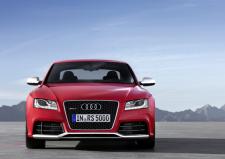
Audi RS5 will present in Geneva Enormous power, packaged in a classy and elegant coupe bodywork: the Audi RS5 will debut at the Geneva Motor Show. High-capacity V8 engine with its 4.2-liter 331 kW (450 hp) provides tremendous opportunities for outstanding performance in terms of fuel consumption. 7-speed S tronic gearbox and a new central mechanism for the propulsion differential transmit power to the quattro all-wheel drive.

RS models developed by quattro GmbH, a leading edge in the dynamic range Audi. RS5 continues this tradition, which began in August for over 15 years ago with the RS2 Avant embodies the concept of being an excellent vehicle dynamics in the middle class.

High-V8 engine with a capacity of 4163 cm3 is closely related to the V10 high-performance driving a sports car R8. Like almost all petrol engines Audi, used in the direct fuel injection - FSI technology. Thanks to the Audi R8 race car won four times in the legendary race at Le Mans. Common Rail system produces a pressure of 120 bars.

The raw performance, a spontaneous reaction to the commands of the driver, the ease of entering the high speed, full sound - V8 engine, hand-produced by Audi, is a fascinating combination of power and emotion. Weighing 1725 kilograms coupe with this engine and accelerates from zero to 100 km / h in 4.6 seconds and develops electronically limited top speed of 250 km / h. On request, Audi set the speed limit of 280 km / h.
Volvo XC60 winning the ADAC test

Volvo XC60 winning the ADAC test ADAC - the largest organization in the automotive world, carry out benchmarking of automatic speed control and distance. The test was attended by 6 cars. Undisputed winner was the Volvo XC60. Automobile Club ADAC (Allgemeiner Deutscher Automobil-Club) has made a comprehensive evaluation function to improve safety in urban traffic. Took the test systems to adjust vehicle speed in the city and the warning systems of impending obstacle.

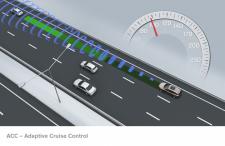
Volvo XC60 won the maximum number of points, thanks to the systems, minimizing the number of accidents in city traffic - ACC (Adaptive Cruise Control) and the City Safety. ACC system helps maintain a safe distance from the car into it fitted with other vehicles. By contrast, City Safety at low speeds (up to 30 km / h), recognizes the vehicles blocking the road, and will automatically braking the car (using laser technology).

Active systems for monitoring the speed and distance are also available in models of the XC70, V70 and S80. The new Volvo S60 will also be equipped with systems for ACC and the City Safety. In addition, S60 was the first car will be equipped with Volvo's active safety systems, Pedestrian Detection system which automatically braking the car and avoid a collision with a pedestrian at a speed of 35 km / h.

Other cars that participated in the test, the Audi A4, Volkswagen Passat CC, Honda Accord, Lexus IS, and Ford Mondeo.

ADAC Automotive is the largest organization in the world, bringing together about 16 million members.

Friday, February 26, 2010

370Z Roadster

The drop-top version of Nissan's iconic Z car makes its European debut at the Geneva Motor Show. Like the CoupĂ© version, the Roadster is powered by Nissan's 3.7-litre V6 producing 241kW (328 PS) and 363Nm, driven through the rear wheels. It's also available with Nissan's unique Syncro Rev Control manual gearbox, which ‘blips' the throttle to ensure perfectly smooth gearchanges every time, as well as a seven speed automatic gearbox with paddle shifts.

Its folding roof disappears in 20 seconds, without need to disconnect securing points on the windscreen and can also be lowered from outside by pressing and holding the door-locking button for three seconds. Customer deliveries begin in March.

The Nissan press conference will be hosted by Carlos Ghosn, CEO, Nissan Motor Co., Ltd at 12:00 on Tuesday 2nd March.

Updated Pathfinder & Navara

A comprehensively refreshed Pathfinder and Navara will also be on display to the public. Its 2.5 dCI engine has been significantly updated, and the overall result is an increase in both power and torque and a reduction in emissions and consumption. Power rises to 140 kW (190 PS) - up 14kW (19 PS) - while torque increases by a healthy 47 Nm to 450 Nm. Over the combined cycle manual versions use 8.4 l/100kms - an improvement of 1.4 l/100kms - while CO2 emissions have fallen by 40g/km to 224 g/km. Both figures are class competitive. A version of the engine with a diesel particulate filter (DPF) is also available in certain markets.

Geneva Motor Show represents also the introduction of a new 3.0-litre V6 diesel engine. Power output is 175 kW (238PS) while the torque output of 550 Nm leads the class.

Further updates have been made to the interior to improve quality, comfort and refinement. Customer deliveries begin in March.

Updated Qashqai

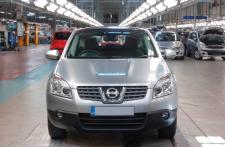
Nissan's mid-size Crossover, the Qashqai, has undergone an extensive update to cement its position as the class-leading, pioneering alternative to the traditional hatchback in Europe.

The most notable visual change to the Qashqai is at the front, where a complete makeover has taken place. All new bonnet, front bumper, wings, grille and headlamps combine to give the Qashqai an air of added sophistication, presence and quality. The new frontal aspect is shared with Qashqai+2. Interior updates give a more premium feel as well as more practicality.

Changes to the Qashqai's underfloor design have helped to optimise airflow, also contributing to the reduction in drag from 0.34 to 0.33 Building on the improvements to the aerodynamics of the refreshed Qashqai, a new Eco version of Qashqai will be introduced with a reduced CO2 output.

A weight reduction programme, the adoption of aerodynamic wheel covers, combined with the blanking of the fog lamp sockets, the fitment of low rolling resistance tyres and the lengthening of the final drive ration have all combined to reduce the Qashqai's CO2 from 137 to 129g/km.

Leaf

LEAF is Nissan's C-segment family car offering all the space and practical benefits of any of its conventional rivals... but with one notable difference. It is a pure Electric Vehicle (EV), promising zero tailpipe emissions and low running costs. LEAF is the first purpose-designed mass-produced EV from any major motor manufacturer and is just the first in a range of EVs due from the company and from Nissan's Alliance partner Renault.

Built on an all-new bespoke EV platform, LEAF sits on a generous 2700 mm wheelbase. It is 4445 mm long, 1770 mm wide and 1550 mm tall. Power comes from an in-house developed compact electric motor in the front of the car driving the front wheels. The AC motor develops 80 kW of power and 280 Nm of torque, enough for a maximum speed of more than 140 km/h (90 mph).

A full battery charge delivers a range of approximately 160km, which will suffice for 80 per cent of European customers who drive less than that on an average day.

The electric motor is ‘fuelled' by a Nissan developed laminated lithium-ion battery with a power output of more than 90 kW. The 48 module battery is mounted under the seats and floor of LEAF. Regenerative energy reclaimed under braking and coasting is fed directly to the battery to ensure minimum waste of energy.

Using a DC 50kW quick charger, the battery can be charged to up to 80 percent of its capacity in under 30 minutes. Until quick charging posts are commonplace, however, it is expected that most owners will charge their vehicles either at home or at work using a domestic 220~240V and 16 amp system. A full charge from 0 percent to 100 percent under these circumstances takes about eight hours. The recharging socket for normal charging and quick charging is conveniently placed on LEAF's nose under a ‘fuel filler flap' adorned with the Nissan logo.

Order books will open in selected European markets in the summer with the first batch

of cars, all left-hand drive and due in late 2010

Juke

Designed to bring a breath of fresh air to the B-segment, where customers are uninspired by the lack of originality on offer, Juke is a distinctive combination of SUV toughness and sporting style in a compact package.

It will be the third member of Nissan's crossover family, reinforcing the company's position as a pioneer of this increasingly popular configuration of vehicle.

The top of the range Juke will come with a new turbocharged direct injection petrol engine, developing 140kW (190PS) and 240 Nm.

The 1.6 direct injection turbo engine is available with Nissan's ALL-MODE 4x4-i system, updated to include torque-vectoring technology. As well splitting torque front to rear - up to a maximum of 50:50 - it can now be split from side-to-side across the rear axle too, enhancing agility and reducing understeer when cornering.

The inclusion of this innovation is a first in the small car segment - a technology that has, until now, only been found on top-of-the-range, premium vehicles.

The other engine options are Nissan's 1.6-litre 16-valve unit, now with a unique dual-injection system, developing 86kW (117 PS) and 157Nm of torque, as well as the 1.5-litre dCI common rail engine producing 81kW (110PS) and 240 Nm of torque.

As well as being sold in Europe (from the autumn), Juke will also be sold in Japan and North America.

Friday, February 19, 2010

Nissan launches third shift

Nissan launch third shift In response to continued high demand for an excellent model Nissan Qashqai will temporarily resume production at the third change in the plant in Sunderland. Throughout the 2009 years the factory has sought to meet the procurement working on two developments, but sales of the popular crossover has reached a level at which the supply has not kept pace with demand.
Since March the model will be even more attractive because of their sales in Europe will thoroughly modernized version of it.

Therefore, the production line since May, on which arises Qashqai will also work the night shift. It is expected that the production of additional change will continue for about six months, but these plans will review course market.

With the opening of the new changes in work will retain 160 temporary workers currently employed. In addition, next month will start in 400 consecutive recruitment of workers who receive a contract of employment on a production line for a specified period. It is anticipated that the additional jobs will be created also in Nissan's subcontractors in the supply chain.

Sunday, February 14, 2010

Nissan Juke

Nissan Juke February 10, 2010, Nissan introduced the first of a new small crossover Juke.
Juke will be manufactured in Europe - in the English factory Nissan in Sunderland - and Oppama (Japan). Production of this model in Europe, as well as a compact family car Note and Qashqai crossover, it is possible thanks to investments exceeding 60 million.

Juke sales begin in summer in Japan and then in autumn in Europe and North America.

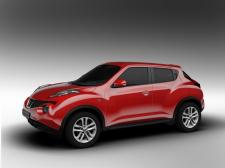
In the lower part of the body Juke is a typical SUV with a powerful wheels, wide tires, high ground clearance and a massive attitude. However, the upper part undoubtedly comes from the sports car, with high windows, extending the lower edge of referring to the shape of the glass and drop a motorcycle helmet in the coupe like roof line. Recalls coupe body also due to the fact that the rear side door latch was hidden in the edge.

There is also a sports atmosphere in the interior. Subordinated to the driver's cockpit is dominated by a central console, which recalls the shape of motorcycle fuel tank.

Dimensions of the whole body is 4135 mm long, 1765 mm wide and 1570 high. The front-drive versions of the suspension used MacPherson strut front and torsion beam rear, while the version with four-wheel drive is equipped with a rear suspension inspired by the solution used in the Qashqai.

In Europe, sales of the model will begin later this year. From the beginning of the car will be offered the choice of three engines: one diesel and two petrol units of 1.6 liter. All engines meet the emission standard Euro 5 The strongest engine is the new turbocharged gasoline unit (MR16DDT) with direct fuel ejaculation. The engine is one of the strongest in its class and develops a power of 140 kW (190 hp) and maximum torque of 240 Nm. Direct injection and turbocharging provide strength and flexibility comparable with an engine capacity of 2.5 liter at a typical fuel consumption for a smaller unit.

The second petrol engine is a newly developed version of Nissan's proven family unit HR. HR16DE engine bearing the sign is a lightweight 16-valve unit with reduced friction, and equipped with a unique dual injection allows more precise indication of the fuel to improve combustion efficiency. The engine develops a power of 86 kW (117 hp). K9K diesel engine 81 kW (110 hp) is a 1.5-liter dCi with common-rail, characterized by excellent flexibility with maximum torque (240 Nm) and low fuel consumption and emissions.

In the car with the drive axle turbocharged gasoline engine 1.6 works with the standard 6-speed manual gearbox.

XTRONIC CVT gearbox with 6-speed manual mode will be available in the richest version of Juke with 4 wheel drive and turbocharged gasoline engine.

Audi A1

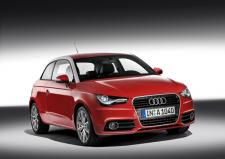
Audi A1 This summer, Audi will introduce a compact class car in a completely new dimension. A dynamic and high quality, expressing emotions, and have individual character.
The car, which combines all the advantages of the brand over a length of less than four meters - a full expression of style, uncompromising quality and pioneering technologies in efficiency.

Sporty interior, the Audi A1 of the highest quality. Customers can be shaped in many details according to their individual tastes. Audi has the youngest on board his rich portfolio of cutting-edge technologies. Audi A1 is the first premium car in the class of small compact cars - a real, wholesome Audi.

In all variants A1 convinces low fuel consumption - from 3.8 to 5.4 liters per 100 kilometers (provisional value). 1.6 TDI engine generating 66 kW (90 hp) with manual transmission emits only 99 grams of CO2 per kilometer (provisional value). All versions are equipped with the system of recuperation and the start-stop system. 1.2 TDI has a new temperature management system with adjustable water pump to reduce fuel consumption.

Audi A1 is a sport, a strong and attractive. As a new model in the compact car segment is directed to a modern group of clients - young people, with the metropolis. A1 customers are interested in design, music, fashion and sports, will be among them many women.

New Volvo S60

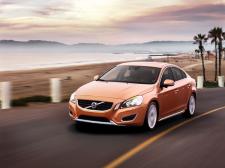
New Volvo S60 The new Volvo S60 has a more dynamic and sporting character, than any earlier model of the brand. Virtually all car lines create a dynamic profile, which seems a lot more body types than the sedan coupe. Roof line, the unique shape of the bonnet to emphasize the sporty character of the car.
The car is offered with two types of suspension. On the European market will be the standard for sport. By contrast, in most markets in North America and Asia, the car is equipped with a comfortable suspension, a sporty variant is an additional option.
Volvo's new model is equipped with the latest technology to improve security, and real sports cars driveability. New Volvo S60 has received the first breakthrough in the field of active safety, Pedestrian Detection system and a new, more advanced control system stability control.

In addition to the City Safety system that is standard, the new Volvo S60 is equipped with a system for detecting and responding to pedestrians emerging from the car (Pedestrian Detection).
Pedestrain Detection system is part of Collision Mitiagtion Support with automatic braking and avoids the impact of pedestrians at speeds up to 35 km / h when the driver does not react. At higher speeds, the main goal is to reduce the impact speed of pedestrians. Blow to the pedestrian at a slower speed means a significant reduction in serious injury to pedestrians. For example, as a result of action of Pedestrian Detection speed will be reduced from 50 km / h to 25 km / h risk of fatal pedestrian injuries decreased by more than 20%, and in some cases by as much as 85%.

The new S60 is the first sedan in the market equipped with a system ASC (Advanced Stability Control) while conducting an aggressive drive to improve the car, cornering performance and high-speed maneuvers.

At the time of the introduction of a car for sale, it will be offered with four types of drive units. Two petrol engines with a capacity of 3.0. 2.0lo capacity and 304 hp and 203 hp. And also two diesel units with a capacity of 2.4l. 2.0lo capacity and 205 hp and 163 hp. In the first year of production range of engines will be complemented by a further 3 gasoline and one diesel. Displacement petrol drive units is 2.0l. and 1.6l. The range of diesel engines will be complemented by individual DRIVE, cylinder capacity of 1.6l., 115 hp, and average fuel consumption of 4.3 l/100 km. Models equipped with a diesel unit is a low fuel consumption - less than 6 l/100 km, and low emissions, up to 115 g / km for carbon dioxide.

Tuesday, February 9, 2010

Volvo V70 and S80 with CO2 emissions below 120 g / km

Volvo V70 and S80 with CO2 emissions below 120 g / km Ecological models of the Volvo fleet completed the V70 and S80 diesel marked DRIVE. Their exhaust emissions is just 119 g / km. This is the fourth and fifth Volvo model, with CO2 emissions below 120 g / km.
Volvo S80 and V70 are equipped with a Drive-ignition engines with a capacity of 1.6-liter 109 hp, which reach a very high torque of 240 Nm. Due to the requirements of low CO2 engines available with a manual transmission.

Low CO2 emissions are an advantage resulting from a very low fuel consumption of green Volvo. Fuel consumption in both models was reduced to 4.5 liters per 100 kilometers.

Lower fuel consumption could be obtained by using:
- Energy recovery system and recharge the battery in the absence of engine load, for example, while driving down the hill;
- Reduce friction and reduce the individual items of equipment such as load-driven air conditioning compressor.

Volkswagen Golf - safest car in 2009 years

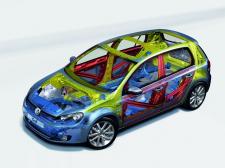
Volkswagen Golf - safest car in 2009 years Institute summed up all the EuroNCAP crash tests conducted in 2009 and chose the safest car. The winner was the Volkswagen Golf, which has acquired a total of 103 points.

Golf in 2008, he received five stars in EuroNCAP tests. In force since 1997, the procedure was evaluated resistance to frontal and side crash and were taken into account the protection of pedestrians. At the beginning of last year expanded the range of tests were also tightened the criteria for evaluation.

Golf was re-examined and obtained excellent results in all four categories (adult occupant protection, child protection, pedestrian protection systems, increasing safety and driver support). Bestseller from Wolfsburg has once again received five stars gaining 103 points, which earned him the title of "safest car of 2009. New, stricter EuroNCAP crash tests have been subjected to a total of 33 cars.

The more stringent assessment procedure included as well as electronic systems increase security and driver support that help to prevent serious injuries and accidents. Golf ensure maximum safety, the Polish market is equipped with such standard a set of seven airbags, which consists of front and side airbags for driver and front passenger, driver's knee airbag and curtain airbags. Among the series systems include: ABS-assisted braking system to prevent slipping drive wheels when starting (ASR), an electric differential lock (EDS), the system prevents wheel slip when braking engine (IAS) and Isofix anchorage for two child seats in the rear bench seat . In addition, ESP series are equipped with the DSG Golfy or drive and 4Motion BlueMotion versions of Technology, GTI, GTD, and R.

Volkswagen Golf not only meets European safety standards. In 2008, this compact car has received a prestigious award "Top Safety Pick" awarded by the independent U.S. safety institute "Insurance Institute for Highway Safety (IIHS). Tests conducted by the organization include frontal impact at 40 mph (64 km / h) and collision side at a speed 31 mph (50 kph) with a sliding barrier, which corresponds to the form of forward SUV. In addition, also examined the behavior of the seats in the rear impact in the body.